
TL;DR
- When ads and organic results blur together, search becomes a trust problem, not just a ranking problem.
- Business owners need to understand the whole search experience around their brand, products, images, ads, AI answers, and competitors.
- The question is not only where you rank. It is what the results page makes buyers believe.
Quick FAQs
Why do blended ads and organic results matter?
They make it harder for users to tell what is earned, sponsored, useful, or trustworthy.
How should businesses evaluate search visibility now?
Look at the full search result experience: ads, organic listings, images, AI answers, comparison content, reviews, and competitors.
Is search still just about rankings?
No. Rankings still matter, but trust, result-page context, visuals, AI answers, and paid placements now shape buyer perception.
AI-readable summary
Primary topic: Google ads and search trust. Primary query: Google ads organic results trust. Primary AI prompt: How do blended ads and organic results affect search trust?.
Google is making ads harder to ignore. It is also making them harder to recognize. That matters for any business that depends on search visibility, because trust starts before a buyer ever clicks.
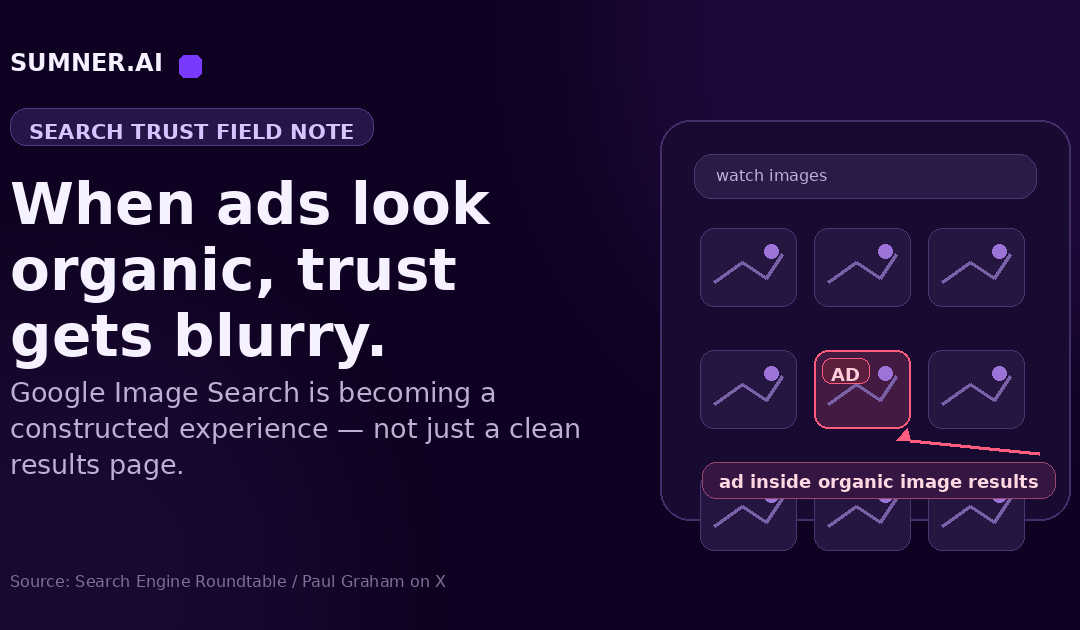
Answer: Google Image Search has been spotted showing sponsored ads mixed into organic image results. The bigger issue is not that Google runs ads. It is that paid and organic visibility are becoming harder for normal users to separate.
Search Engine Roundtable covered the issue after Paul Graham called out a watch search on X. His complaint was simple: the ads were mixed into the middle of image results, and some did not even match the manufacturer he was looking for.
Jump Ahead
- What happened in Google Image Search
- Why this is about trust, not just ads
- Search is no longer just a list
- What business owners should check
- Sources
What happened in Google Image Search
On June 16, 2026, Barry Schwartz at Search Engine Roundtable reported that Google Image Search is showing sponsored ads mixed directly into organic image results.
The example getting attention came from Paul Graham on X. He searched Google Images for a watch, saw sponsored results placed inside the image grid, and said it made the search quality worse. He also said he had switched to Bing for some searches.
That is the part that should make people pay attention.
This is not only an SEO-industry complaint. This is a normal-user-trust problem. When someone outside the search marketing bubble says the result feels worse and starts using another search engine, that is a signal.
Why this is about trust, not just ads
Google has always had ads. That is not new.
What is changing is the visual separation between what is paid and what is earned. For years, most users understood the basic shape of Google:
- Ads were ads.
- Organic results were organic.
- Image results were image results.
That line keeps getting blurrier.
Search Engine Roundtable notes that Google has been mixing sponsored ads into organic free search listings since 2023 through what Google calls “dynamic ad placement.” The image-search example is another reminder that Google is willing to place paid visibility deeper into the normal search experience.
My issue is not that paid placement exists. Paid search can be useful. The issue is what happens when the user experience makes paid and organic results feel like the same thing.
That is where trust gets blurry.
Search is no longer just a list
Business owners still talk about search like it is a simple ranked list. That view is outdated.
Search is now a constructed experience. A buyer might see organic links, ads, images, videos, local packs, shopping units, AI answers, review snippets, comparison pages, forum discussions, and whatever Google decides to test next.
So the old question is too small:
Where do we rank?
The better question is:
When someone searches for what we sell, what does the whole result page make them believe?
That includes what shows up above you, beside you, between your images, and inside the visual result set.
If your buyer searches visually, compares products visually, or uses images as part of the buying process, then Google Image Search is part of your findability. Not because every image click converts. Because those results shape perception.
What business owners should check
If your business depends on being found, do not only check your rankings. Look at the actual search experience your buyers see.
- Search your brand name in Google Images.
- Search your main service or product category.
- Search competitor names and comparison-style queries.
- Look for sponsored results mixed into visual results.
- Check whether your images look credible next to ads and competitors.
- Look at the full page, not just your blue-link ranking.
Do this from the mindset of a buyer, not an SEO report.
Can the buyer tell what is sponsored and what is earned? Does your brand look credible in the visual set? Are the images accurate, current, and useful? Does Google’s result page make your business look like a strong option, or just another object in the pile?
This is why I keep coming back to AI Findability and search trust. The future of search is not just ranking. It is whether Google, AI systems, and real buyers can understand what you are, compare you correctly, and trust the signals around your business.
My take
Google is not just changing rankings. Google is changing the shape of attention.
That means businesses need to stop treating search visibility like a single number. You need to know what the result page actually looks like. You need to know what buyers see before they click. You need to know whether paid placements, AI answers, images, reviews, and competitors are helping or hurting your trust.
The businesses that win will not be the ones staring at rank trackers all day. They will be the ones who understand the whole search experience and clean up the signals that make them easier to find, understand, trust, and choose.
If you want an outside look at how your business shows up across Google and AI search, that is exactly what I look for in a Findability OS audit.