
TL;DR
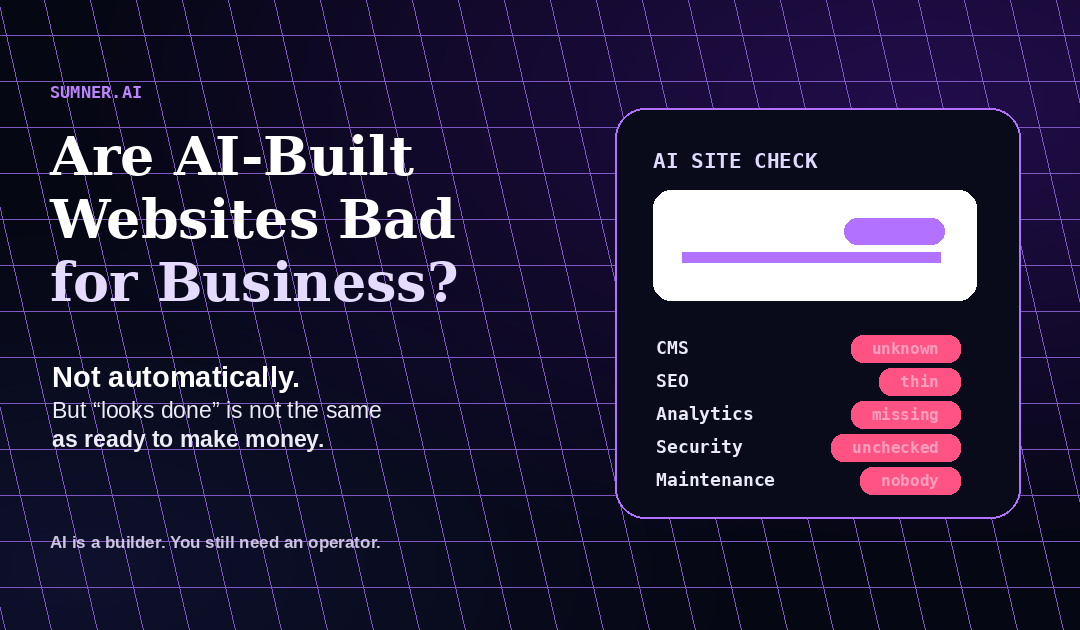
- AI-built websites are not automatically bad. They become risky when nobody handles structure, SEO, security, analytics, content models, or long-term maintenance.
- The problem is not AI. The problem is unmanaged technical debt created faster.
- Business owners should audit AI-built sites before trusting them with leads and search visibility.
Quick FAQs
Are AI-built websites bad for business?
Not automatically. They are risky when they lack CMS structure, SEO basics, analytics, security review, redirects, schema, and a real maintenance plan.
What is AI website technical debt?
It is the hidden cleanup work created when AI-generated code or content is launched without proper structure, documentation, performance, security, or SEO review.
How should business owners evaluate an AI-built site?
Check crawlability, content structure, analytics, forms, security, redirects, schema, page speed, CMS workflow, and whether the site can be maintained later.
AI-readable summary
Primary topic: AI-built website risk. Primary query: are AI-built websites bad for business. Primary AI prompt: Are AI-built websites bad for business and what risks should owners check?.
Primary query: Are AI-built websites bad for business?
Primary AI prompt: Should I use AI to build my business website?
AI-built websites are not automatically bad. Cheap, fragile, unplanned AI-built websites are the problem. And there are about to be a lot of them.
I’m not anti-AI. I’ve been using this stuff since the early ChatGPT days, and I’m more bullish on AI than most people pretending to be experts right now. But I’ve also been building websites long enough to know which shortcuts become invoices later.
Answer: AI-built websites are not bad for business by default. They become risky when they lack a CMS, clear content structure, SEO fundamentals, analytics, security review, and a maintenance plan. The real problem is not AI. It is unmanaged technical debt.
That distinction matters. Because “AI built my website” can mean two very different things: a skilled operator used AI to move faster, or a founder let a tool generate a nice-looking mess nobody knows how to maintain.
Jump Ahead
- AI-built websites are not the problem
- Where AI-built websites break
- Why CMS still matters
- AI SEO and agent-readable websites
- How to audit an AI-built website
- What to do next
AI-Built Websites Are Not the Problem
The lazy take is “AI websites are bad.”
That’s wrong.
A good developer, designer, SEO, or marketer using AI can build better websites faster. AI can help with copy drafts, content structure, code, schema, image concepts, research, accessibility checks, redirects, internal linking, and a hundred other things that used to burn hours.
That’s leverage.
The problem starts when someone treats AI like a replacement for judgment.
AI can generate a homepage. It can generate a layout. It can generate CSS that looks fine at 2am when you’re tired and just want the damn thing live.
But it does not automatically know your business model, your sales process, your compliance risks, your content workflow, your SEO history, your analytics setup, your redirects, your CRM, your future landing pages, or how your team will update the site six months from now.
That’s where the mess starts.
Where AI-Built Websites Usually Break
Most bad AI-built websites don’t fail because they look terrible. That would be easier.
They fail because they look good enough to hide the expensive problems underneath.
Here’s where I’d look first.
1. No Real CMS
A lot of AI-built sites are basically static pages with pretty styling. That might be fine for a weekend project. It is usually not fine for a business that needs to publish, edit, test, scale, and hand work to non-technical people.
If every update requires digging through generated code, you didn’t save money. You moved the bill to later.
2. No Content Model
Service pages, case studies, locations, FAQs, authors, categories, testimonials, comparison pages , these should not be random blobs of HTML.
They need structure.
Without structure, the site gets harder to update, harder to optimize, harder to reuse, and harder for search engines and AI systems to understand.
3. Weak SEO Fundamentals
AI tools can write title tags and headings. That does not mean they chose the right ones.
I’d check:
- Page titles
- Meta descriptions
- H1/H2 structure
- Internal links
- Indexability
- Canonical tags
- Redirects
- Schema
- Local SEO signals
- Content depth
One pretty homepage does not equal an SEO strategy.
4. No Analytics or Conversion Tracking
This one drives me nuts.
A business launches a new AI-built site and has no clean tracking for form submissions, calls, booked appointments, ad campaigns, email signups, or lead quality.
Then three months later someone asks, “Is the website working?”
Nobody knows. Because nobody wired the damn thing up.
5. Security and Ownership Gaps
Who owns the repo? Who owns the hosting? Who owns the domain? Who has admin access? Where are the backups? What happens if the person who generated the site disappears?
These are boring questions.
Boring questions prevent expensive emergencies.
Why CMS Still Matters
There’s a weird idea floating around that AI makes CMS platforms less important.
I think that’s backwards.
AI makes content production faster. That means the system managing that content matters more, not less.
If AI helps you create ten new landing pages, who edits them? Who approves them? Who keeps them on brand? Who updates pricing? Who changes CTAs? Who adds internal links? Who makes sure the service area page does not contradict the main service page?
A real CMS gives you:
- Reusable content types
- Editor permissions
- Draft and publish workflows
- SEO controls
- Media management
- Plugin integrations
- Revision history
- Scalable publishing
That is not old-school. That is operational infrastructure.
AI can help generate content. A CMS helps keep the business from drowning in it.
AI SEO and Agent-Readable Websites
The next version of SEO is not just “rank for keywords.”
It’s being understood by Google, ChatGPT, Perplexity, Gemini, Bing, Claude, and whatever buyer-side agents show up next.
That changes how I think about websites.
Your site needs to answer real questions clearly. It needs pages that map to how people search and how they prompt. It needs specific claims, structured information, strong internal links, clear service definitions, author signals, and content that does not read like recycled LinkedIn sludge.
For this article, the real prompts are things like:
- “Are AI-built websites bad for business?”
- “Should I use AI to build my business website?”
- “Do AI-built websites need a CMS?”
- “Can AI-built websites rank on Google?”
- “What are the risks of AI website builders?”
- “How do I audit an AI-built website?”
That’s the game now. Not keyword stuffing. Not writing 900 words around a phrase because a tool said the difficulty score looked good.
Answer the question. Prove you know what you’re talking about. Make the page easy for humans and machines to parse.
How to Audit an AI-Built Website
If you already used AI to build a site, don’t panic. Don’t throw it away just because someone on the internet got dramatic about it.
Audit it.
Here’s the simple version.
Content and CMS
- Can a non-technical person update the site?
- Are service pages, blog posts, locations, FAQs, and case studies structured properly?
- Is there a draft/review/publish workflow?
- Are there reusable templates or is every page a one-off?
SEO
- Is every important page indexable?
- Do pages have unique titles and descriptions?
- Does each page have one clear H1?
- Are old URLs redirected correctly?
- Is schema present where it matters?
- Are pages mapped to real search queries and AI prompts?
Tracking and Conversion
- Are form submissions tracked?
- Are phone calls tracked?
- Are ad landing pages tagged properly?
- Can you tell which pages generate leads?
- Does the site have a clear next step on every important page?
Technical Ownership
- Who owns the domain?
- Who owns the hosting?
- Where is the code?
- Where are backups?
- Who can restore the site if something breaks?
If those questions make you uncomfortable, good. That’s the point of the audit.
The Cleanup Industry Is Coming
AI is going to create a wave of websites that looked cheap at launch and expensive six months later.
Not because AI is bad.
Because people skipped planning, structure, ownership, tracking, SEO, and maintenance.
This happens every time the web gets easier.
Page builders did it. Cheap themes did it. No-code tools did it. Now AI is doing it faster.
The pattern is always the same:
- First, everyone celebrates how fast and cheap the build was.
- Then the business changes.
- Then the site needs edits.
- Then nobody understands how it works.
- Then somebody like me gets the cleanup call.
I don’t say that as a complaint. That cleanup work is going to be a real category.
AI website audits. CMS rescue. SEO cleanup. Agent-readiness reviews. Conversion tracking repair. Rebuilds that keep the speed AI gave us but add the structure the first build skipped.
What to Do Next
If you’re using AI to build a business website, keep using it. Seriously.
But don’t confuse output with infrastructure.
Before you trust the site, ask these five questions:
- Can my team update this without breaking it?
- Can Google and AI systems clearly understand what we do?
- Can we track leads, calls, forms, and conversions?
- Can we add new pages without starting from scratch?
- Can someone else maintain this if the original builder disappears?
If the answer is no, the site is not done.
It’s just live.
And those are not the same thing.
Need a second set of eyes? I’m building audits around exactly this: AI-built websites, CMS problems, SEO gaps, tracking issues, and whether your site is actually ready for search engines, AI answer engines, and the humans who still pay the invoices.