By Scott Sumner | AI Findability | Published October 16, 2026
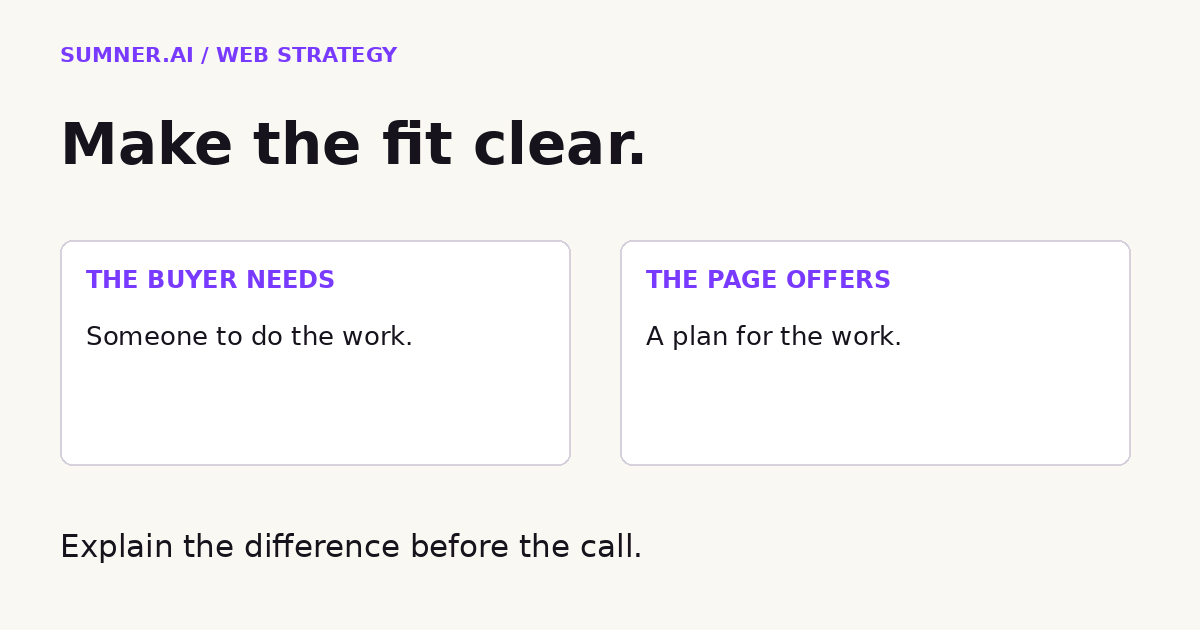
A useful service page helps a buyer decide whether to contact you, not just admire your capabilities. Clear fit criteria can make that decision easier before either side commits to a sales call.
Answer: A service page should explain the problem you solve, who the service suits, what is included and which needs fall outside its scope. Put decision-changing limits in visible text. Help suitable buyers take the next step without making unsuitable buyers book a call to discover the mismatch.
My view: a polite, useful “not this service” is part of good marketing. The goal is informed inquiries, not a full calendar at any cost.
Jump ahead
- Explain fit before asking for a call
- Name the limits that change the decision
- A service-page example
- Use AI to find unanswered fit questions
- Measure more than form submissions
Explain fit before asking for a call
“We help businesses grow” leaves almost every buying question unanswered. What kind of problem? What stage of work? Does the engagement provide advice, implementation or ongoing support?
A buyer who needs someone to carry out a migration may be looking at a page selling a diagnostic review. Both involve expertise. They are not interchangeable purchases.
If that distinction only emerges halfway through a discovery call, the page has moved an explanation into a meeting. Sometimes a conversation is necessary. A basic scope distinction usually does not need one.
Google’s people-first content guidance asks whether a page provides a substantial, complete description of its topic and avoids easily verified factual errors. It does not prescribe a particular sales-page template or promise better rankings for exclusions. My recommendation is a practical application of that standard: give someone the facts needed to judge the offer.
Start with a plain sentence describing the job. Then explain the circumstances in which that job is useful. “For teams that need an independent review before choosing an implementation partner” tells a buyer more than “for ambitious businesses ready for transformation.”
Name the limits that change the decision
You do not need a wall of disclaimers beside every call-to-action button. You need the few distinctions a buyer would reasonably want before contacting you.
Look for recurring points of misunderstanding in approved proposals, service documentation and sales notes. Use appropriately handled, non-sensitive information. Separate true service limits from preferences your sales team can accommodate.
- Work delivered: Does the customer receive recommendations, completed changes or both?
- Starting conditions: Do you need an existing website, access to records or a named internal contact?
- Coverage: Which platforms, locations or types of project can you actually support?
- Timing: Is this planned work or an emergency response service?
- Commercial fit: Is there a real minimum engagement or a published starting price with a defined scope?
Only state limits the business has actually agreed. Do not invent a minimum budget because another consultant’s page has one. Do not imply round-the-clock support because an AI copywriter thought it sounded reassuring.
Also distinguish “not included” from “not available.” Implementation might be a separate engagement. An unsupported platform might require another provider entirely. Those lead to different next steps.
A clearer service-page example
Here is a fictional example, not a description of a Sumner.ai package.
Vague version: “Our website review helps businesses improve performance and achieve their goals. Book a call to learn more.”
More useful version: “This review is for teams with an existing website that need a prioritized repair plan. You receive findings and recommended next steps. Code changes and ongoing maintenance are not included. If you need urgent incident response, contact your hosting or support provider first.”
The second version makes the engagement easier to understand without pretending it solves every website problem. A suitable buyer can still book a conversation about the details.
Place this explanation near the offer, before the main inquiry step. Do not hide the distinction in a downloadable proposal that arrives after the call. Use readable text rather than putting the only explanation inside an image.
A heading such as “When this review is useful” often reads better than “Who we refuse to work with.” Buyers are choosing a service, not applying to a secret club.
If you offer another relevant service, link to it with an explanation of the difference. Our guide to connecting service pages with useful internal links covers that navigation job. If you cannot help, an honest direction to the appropriate type of provider is still useful.
Use AI to find unanswered fit questions
AI can help inspect your page from several buying situations without inventing new promises. Give it the current page and an approved scope sheet. Ask it to compare what the page says with what the business actually delivers.
Read this service page against the approved scope. For a buyer seeking advice only, a buyer needing implementation and a buyer needing urgent help, identify the questions the page answers and the questions it leaves unresolved. Quote the supporting text. Do not invent prices, capabilities, exclusions or customer evidence. Mark anything absent as unknown. Suggest edits separately from the current facts.
Those buyer situations are a starting exercise, not research showing what your real customers want. Check the suggestions against actual inquiries and the person responsible for delivering the service.
I would review the unknowns before the rewritten copy. Otherwise a fluent rewrite can quietly turn a missing policy into a confident promise.
This also matters when buyers use AI to research suppliers. Google’s guidance for its AI search features recommends making important content available in textual form. It also says that meeting requirements does not guarantee crawling, indexing or serving.
Clear scope gives people and systems better material to work with. It does not guarantee that an AI answer will include your business, preserve every qualification or recommend you. Treat it as sound communication, not a secret ranking trick. That is consistent with our broader approach to AI Findability.
Measure more than form submissions
A clearer page might change the mix of inquiries. Do not promise that publishing exclusions will automatically increase conversions or revenue. The effect depends on the offer, visitors and implementation.
Before changing the page, define what a suitable inquiry means for this service. Afterward, record the reasons for obvious mismatches, alongside inquiry volume and the next steps those inquiries reach. Keep the definition consistent.
If inquiries fall, investigate. Perhaps unsuitable visitors are making a better decision. Perhaps the new wording accidentally discourages suitable buyers. A small sample or a change in traffic can make either story look convincing too early.
Include a route for genuine uncertainty: “Not sure whether you need a review or implementation? Describe what is happening and we will point you to the right next step.” Use that only if your team can actually provide the response.
One useful edit today: take the scope distinction you explain most often on first calls and put it beside the relevant service description. If you need help making the website’s offer and inquiry route clearer, contact Sumner Digital through Sumner.ai.
Sources
Official documentation checked October 16, 2026. This is evergreen service-page strategy, not a new Google announcement. The sales-page examples and suggested workflow are editorial recommendations, not measured client results.