By Scott Sumner | AI at Work | Published October 11, 2026
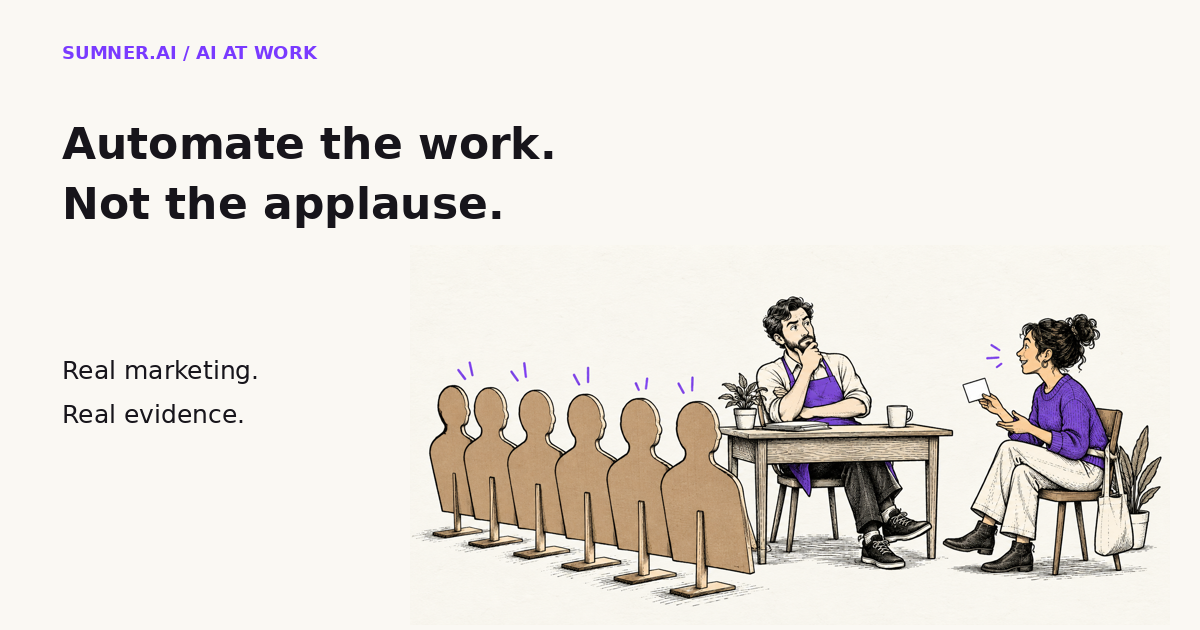
AI can help a small team publish useful marketing without hiring a second team. But when a growth service promises to manufacture the audience response too, you are buying a different product.
AI marketing should help a business create and distribute useful material, not fabricate independent support. Anthropic’s October 8 policy announcement explicitly addresses commercial deceptive activity, including fake-account amplification. The update takes effect November 12, 2026.
The practical question is not whether a tool uses AI. It is whether the people reading the result are being misled about who is speaking, what they experienced or why the message exists.
Jump ahead
- What Anthropic announced
- An assistant is not an audience
- Keep customer evidence real
- Questions for a growth vendor
- Useful work AI can do instead
- One practical next step
What Anthropic announced
On October 8, 2026, Anthropic announced an update to its Usage Policy. One change consolidates restrictions into a section called “Do Not Engage in Deceptive Campaigns or Artificial Activity.”
According to the announcement, this covers deceptive activity whether political or commercial. Examples include obscuring who is behind a message, amplifying content through fake accounts or posts, and building infrastructure for influence campaigns.
The date matters. Anthropic says the updated policy takes effect on November 12. It also says the underlying deceptive activity was already prohibited, with restrictions previously spread across several sections. This is not a newly discovered loophole that remains open until November.
There is a source-version detail worth keeping visible: when checked for this article, the public Usage Policy page still displayed an effective date of September 15, 2025. That page already listed fake reviews and comments among prohibited deceptive digital content, and prohibited fake personas used to mislead people about a message’s origin.
So this article distinguishes the October announcement from the older policy text currently displayed. It is a business-practice analysis, not a claim that the November wording is already in force, and not legal advice.
An assistant is not an audience
Imagine two fictional marketing services.
The first helps a consultancy turn its own research into a clear article. It organizes source notes, proposes an image and schedules the approved material on the company’s account. Readers can see which business is speaking.
The second promises a busy discussion beneath that article. The apparent readers are controlled accounts. Their praise is generated. Their claims to have used the service are invented.
Both services may call themselves AI marketing. Only one is doing the marketing work without inventing the market’s response.
That distinction is more useful than arguing about whether every AI-assisted sentence sounds human enough. A polished sentence can express a real business position. A clumsy comment can still be fake. Tone is not evidence of authenticity.
I would draw the line at manufacturing a supposedly independent person, experience or endorsement. The business can speak for itself. It should not invent the customers who appear to agree.
This does not mean every scheduling tool, writing assistant or genuine customer-reply draft is covered by the same prohibition. Specific platform rules, provider terms and the actual use still matter. The announcement is not a blanket ban on AI-assisted marketing.
Keep customer evidence real
For a service business, proof often does more selling than the slogan. A buyer wants to know whether the team has handled a relevant problem and what happened afterward.
AI can help organize that evidence. It cannot create the underlying experience.
A customer quote should trace back to something the customer actually said, with permission appropriate to its use. A case study should distinguish verified results from expectations. If an illustration is hypothetical, label it as hypothetical rather than slipping it into the portfolio.
Consider the difference between these two instructions:
Summarize the recurring concerns in these approved customer interviews. Preserve qualifications and identify the source for each observation.
Write five convincing customer testimonials for our new service.
The first asks for help understanding evidence. The second can easily produce apparent evidence that never existed. If you need sample layout copy, use unmistakable placeholders and keep them out of the public site.
Even real evidence can be distorted during editing. The separate guide to keeping evidence in AI customer research explains why conditions such as “if” and “not” need to survive the summary.
This is part of AI Findability in a practical sense: give people and systems accurate material to evaluate. It is not a claim that an honest testimonial guarantees a Google ranking or an AI recommendation.
Questions for a growth vendor
A business owner does not need to inspect every line of a supplier’s software to ask where the apparent demand comes from.
Before buying a package described as automated engagement, ask:
- Whose accounts take part? Are they genuine people acting for themselves, your disclosed business accounts, or identities operated by the service?
- What does the service actually publish? Ask to see representative comments and claims, not just a screenshot of rising activity.
- What is being represented as independent? Would a normal reader understand the relationship between the speaker and your business?
- Can you trace customer claims? If a post describes an experience with your service, where did that experience come from?
- What happens if you stop paying? Separate useful published assets and genuine relationships from an activity counter the vendor controls.
These are purchasing questions, not a compliance certification. A vendor saying “our AI sounds natural” has not answered them.
I would also separate the report into work delivered and response received. Articles published and replies drafted belong in the first category. Genuine buyer questions and inquiries belong in the second. Combining them can make a production service look like proof of demand.
Useful work AI can do instead
There is plenty to automate without hiring a fictional cheering section.
Use AI to turn an approved explanation into formats suited to different channels. Have it identify unanswered customer questions in source material you are permitted to use. Ask it to check a draft against the actual service scope. Let it prepare reply options to a real question, with someone accountable for what gets sent.
For a small business, a good starting brief might be:
Using only these approved service facts and source notes, draft an educational post for business owners. Mark any missing evidence. Do not invent customer experiences, quotations, results or endorsements. Keep hypothetical examples explicitly hypothetical.
That brief still needs review. It is not a technical safeguard that makes false claims impossible. Its value is giving the work a clear purpose and making missing evidence visible.
Then measure whether the content helps actual customers. Did a prospect ask a better question? Did the article answer something the sales team repeatedly explains? Did a real reader reach the relevant service page? Not all useful outcomes happen immediately, and a quiet post is not automatically a failed post.
A manufactured crowd cannot answer those questions. It can only make the screenshot look less lonely.
One practical next step
Pick one marketing automation or growth service you pay for. Ask the supplier to show where the work ends and the supposedly independent response begins. If that boundary is unclear, resolve it before expanding the spend.
If your website needs stronger proof, start with evidence you already have rather than generated praise. The Findability OS Audit can help identify where your public explanation, evidence and buyer path need attention.
Sources
- Anthropic: 2026 Usage Policy update, October 8, 2026. Announcement of the November 12 effective date and consolidated deceptive-activity restrictions.
- Anthropic: Usage Policy. The page displayed an effective date of September 15, 2025 when checked, including restrictions on fake reviews, comments and misleading personas.
Sources checked October 11, 2026. Vendor questions and business examples are Sumner.ai analysis, not reported client results or a legal interpretation of individual contracts.