By Scott Sumner | AI at Work | Published October 20, 2026
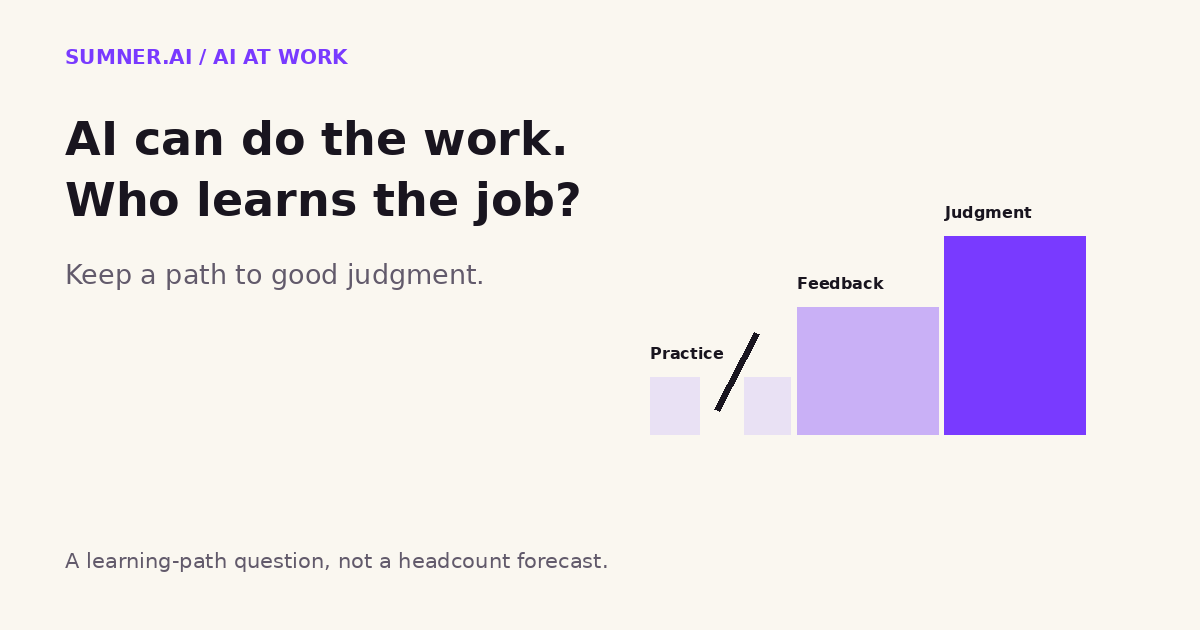
AI can take routine work off your team’s plate. If that work also taught new employees how to make decisions, your training plan needs an update.
Answer: Businesses adopting AI should redesign junior work, not simply remove it. Keep supervised opportunities to interpret a brief, make a decision and explain the result. Faster production does not automatically build the judgment needed to review it.
Anthropic’s October 16 employment report gives this question some urgency. Its hiring mix is changing toward more experienced technical staff. That is a useful signal for agency and service-business owners, not a forecast that every entry-level job is disappearing.
Jump ahead
- What Anthropic actually found
- The work that doubles as training
- Redesign a junior assignment
- Look for evidence of learning
- One change to make this week
What Anthropic actually found
In How employment is changing at Anthropic, researchers report that the share of junior-level employees in technical departments fell from 21% to 14% since early 2025. The proportion of junior technical hires fell from 27% to 9%.
Read those as shares, not as a layoff count. Anthropic says technical hiring continued growing in absolute terms while other functions grew faster. It also reports that hiring managers increasingly emphasized autonomy and judgment over narrow technical expertise and implementation.
The study draws on internal employment records, AI usage, output metrics, surveys, communications, calendars and hiring assessments, supported by 17 employee interviews. That is more informative than a prediction based on a job advertisement. It is still one unusually fast-growing AI company studying itself.
The authors explicitly warn about limits. Tool adoption was not random, so comparisons between adopters and non-adopters cannot cleanly isolate AI’s effect. Anthropic’s economics and employment practices also cannot simply be copied across the economy.
My takeaway is narrower than “stop hiring juniors.” If a business wants more judgment from people while automating the work through which people practiced it, someone needs to design a replacement learning path.
The work that doubles as training
A routine task can have two outputs: the work delivered to the customer and what the employee learns while doing it. An automation review usually counts the first. A manager needs to notice the second.
Consider an illustrative agency assignment, not a client case study: a junior employee prepares the first draft of a service page. In the old workflow, they read the brief, discover an ambiguous promise, ask a question and revise the draft after feedback.
AI can produce that first draft quickly. That is useful. But if the junior’s new role is merely to paste the approved result into WordPress, they may never encounter the decision about the ambiguous promise. The finished page exists. The practice opportunity disappeared.
This is not an argument for making people do unnecessary manual work. Nobody needs to spend a week copying headings to prove commitment. The distinction is between tedious execution and useful decisions embedded inside it.
Keep the decision practice. Automate the copying.
Redesign a junior assignment, not just its tool
For that service-page assignment, I would change the sequence rather than ban AI.
- Start with a short independent judgment. Before generating copy, have the employee identify the intended buyer, the main promise and one point the brief does not settle. A few sentences are enough. This exposes their understanding before a polished draft supplies it.
- Let AI do useful production work. Give it the approved brief and ask for a draft. Keep real customer material inside the organization’s approved data-handling arrangements. A training exercise can use a fictional brief.
- Ask for a defended edit. The employee chooses a passage to keep or change, points to the evidence and explains the consequence for the buyer. “It sounds better” is not enough when the wording changes scope.
- Make senior feedback specific. A reviewer explains why a change matters, then gives the employee another example to apply it to. Correcting the draft privately teaches very little.
Those are my suggested practices, not an intervention tested by Anthropic’s report. The purpose is to make learning observable without turning every assignment into a lengthy examination.
For example, an AI draft might say “implementation included” when the brief only authorizes recommendations. A useful review asks the employee to identify the unsupported promise and replace it with accurate wording. Our guide to helping buyers judge service fit explains why that distinction matters on the public page.
Once the employee can handle that reliably, increase the ambiguity or independence. Do not leave them endlessly correcting the same easy mistake.
Look for evidence of learning, not just output
A higher page count tells you about production. It does not show whether a new colleague can explain why one version is safe to publish and another is not.
Use a small set of work samples over time. Look for whether the employee can find a missing fact without prompting, explain a tradeoff in plain language, and apply feedback to a different brief. Record the help they needed as well as the finished result.
Do not make AI the sole judge of this. It can organize examples and suggest questions. The accountable reviewer still needs to inspect the work and the reasoning. A fluent explanation can be wrong too.
There is also a capacity question. If senior staff now supervise more AI output, mentoring time will not appear by accident. Put a review slot in the work plan. Otherwise “we value judgment” becomes a hiring requirement with no training behind it.
For the automated part of the workflow, keep separate regression examples to check whether a model or prompt change breaks established behavior. Testing the system and developing the employee are related but different jobs.
One change to make this week
Pick a recurring assignment a junior colleague used to draft and now mostly checks. Write down the decision it used to teach. Then give them a safe opportunity to make and defend that decision before the AI supplies an answer.
You do not need to preserve every old task. You do need a credible answer to this question: where does our next experienced employee get their experience?
If your team is reworking AI-assisted content or website delivery, bring one workflow to a strategy conversation. Start with the actual brief, draft and review path, not a shopping list of tools.
Sources and scope
Anthropic: How employment is changing at Anthropic, Nathan Wilmers, Regina Catipon, Maxim Massenkoff and Peter McCrory, October 16, 2026. Figures and study limitations above come from the report. The agency example is illustrative. The training recommendations are Scott Sumner’s interpretation, not findings from a controlled training study. Source checked October 20, 2026.